Showing posts with label Sandwich generation. Show all posts

Tuesday, September 3, 2024

Take Two

As it turns out, I wasn't a blogger.
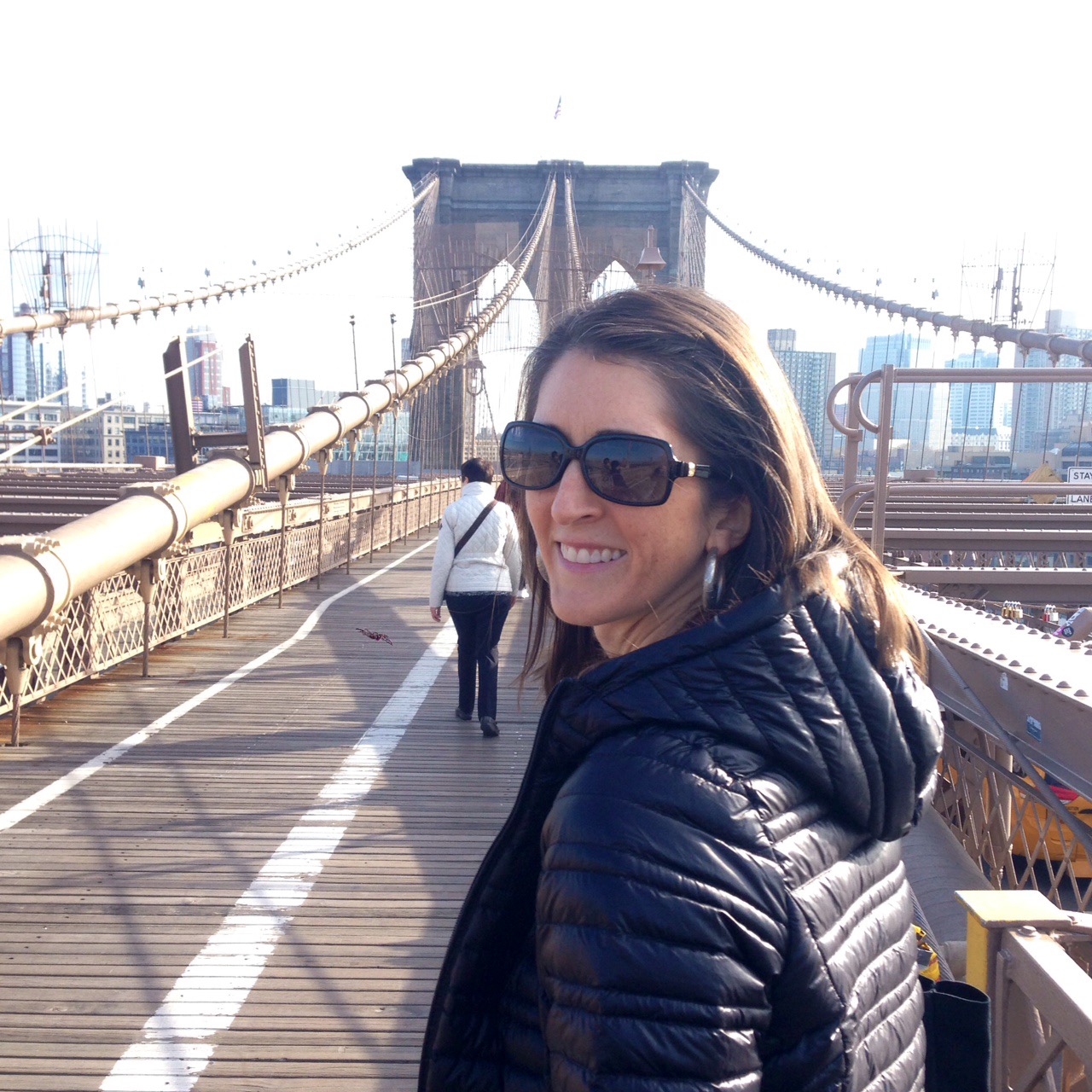
2014 me: not a blogger
Bloggers write and publish on a regular basis. To do that you have to believe in your own writing enough to hit the publish button after writing something. Like in academia, blogging is a publish or perish life.

Which means you have to own your own imperfections, accept that not everyone will like everything you do, and be willing to learn in public. These are three things I could not yet do ~10 years ago, and the result was that my blog's behind-the-scenes dashboard holds 

15 published posts and 

20 unpublished drafts

In other words, the odds of my being unready / unwilling / unable to publish were 4:3.

So why come back here to this space? What's changed since then? 

In June 2018, nine months after I wrote my farewell post on this page, I started a new job. I had been a freelancer for six years and went in-house with one of my clients. We knew this would be a huge transition -- going from a local firm of one to a global firm of 30,000 -- and Nick agreed that it made sense for him to "coast" for a while at work while I onboarded and accelerated. 

Then, while I was in Chicago at my orientation training, a headhunter called him about a fantastic opportunity. The kind that you can't not explore for fear of asking "What if...?" for the rest of your life. I was 100% supportive, of course, and so proud. I think my exact words were "Dude, WHAT THE F*<% happened to the coasting plan?!"

He started his new role (and commuting to a new city) six months later.

In 2020, my daughter graduated from high school, and we learned that car parade graduations are so much more fun than traditional graduations. Seriously, they should make that permanent. Later that summer, our family moved from Denver to St. Louis so Nick could stop commuting and, in my son's words, "we would only ruin one kid's life." 

I don't recommend relocating cross-country in the midst of a global pandemic.

Mad props to my son, who transitioned like a champ. In 2023, he also graduated from high school. While his ceremony had fewer neighbors ringing cowbells and holding up posters in their front yards, the Superintendent did pass out 200 cups of ice cream from Clementines, a local creamery, during her speech, which is about as good as it gets when you're stuck in a robe made from shower curtain material and a weird hat sitting on folding chairs in an auditorium on a hot and humid late-May afternoon.

Both my kids took gap years between high school and college. I've become a convert and sometimes wonder about the potential Sliding Doors storylines of my own life had I spent a year at age 18 recovering from Type-A burnout and giving myself the grace and space to ask who I am outside of others' expectations for me and my path. The good news is that I eventually got there. Or am getting there. Or will get there.

In April, I asked for a demotion at work, effectively undoing the 2½ promotions I had received since 2018. (See burnout, supra). This decision was made far easier once I found out that I was still being paid within the range of my original role and that, while my title would revert, my paycheck would remain the same. Again, I found myself asking, "Dude, WHAT THE F*<%?!"

2024 me: still not a blogger
That particular question has become more of a recurring theme in my life as of late.

Now the kids are barely grown and barely flown. I just moved the Thespian (who still loves but is no longer consumed by theatre) into his dorm for his first year of college, and the Equestrian (who still loves but is no longer consumed by riding) just moved herself into an apartment for her senior year. 

There's a lot to process. A lot to confront. And I find myself called back here. 

So should this page still be The Baloney Sandwich? Indubitably, as I still find myself sandwiched between

  • parenting kids and coaching/befriending young adults
  • navigating my own life and that of my aging parents
  • what Richard Rohr would call the outer task (building the vessel) and the inner task (filling the vessel with purpose)
  • mid-life and whatever's next
Not to mention that most days I feel like Oscar Mayer processed luncheon meat as I battle through perimenopause. (The prefix peri deriving from the Greek meaning "enclosing" or "surrounding." Because we are in it, my friends.)

It's all still baloney.

But this time I am willing to own my imperfections, risk your not liking what I write, and learn in public. This time, odds are better that I'll publish.


Monday, September 11, 2017

Saying goodbye... for now

I began this blog -- if we can even call it that anymore -- because sometimes, over the past five years, as I was in the throes of multi-generational caregiving, there were moments just too absurd to keep to myself.

And then there were moments just too sad or painful to capture in irreverent short-form writing.

The last few years, since my father-in-law moved from independent to assisted living, there have been more of the latter and fewer of the former. If you had administrative access to this blog, you would see 14 unfinished drafts. I couldn't seem to get it right, which perhaps offers a bit of psychological insight into how all caregivers of aging parents feel. We start something we hope will work -- a prescription, a therapy, a regimen, an approach -- and then, for some reason or another, have to change course and try again.

Hence the lack of logging in my blogging.

In May of this year, we said our final goodbyes to Renzo. And today I am saying goodbye to this phase of The Baloney Sandwich. It may come back again in another form -- goodness knows my life is never devoid of The B.S. -- but there are other aspects of life and love about which I feel more compelled to write at this point.

For my final post, I thought I'd share the eulogy I wrote for Renzo's funeral. Perhaps that way, anyone who comes across these sparse pages will know the fullness of his life rather than just the fraction of himself he was at the very end. We miss you, Grandpa. Every day.


*   *   *


Renzo Barto, 1932-2017
I recently finished reading a memoir entitled The Other Wes Moore. In it, the author recalls one of his commanding officers at Valley Forge Military School addressing the cadets. Colonel Murphy was a “no excuses” kind of guy. When he was diagnosed with late-stage cancer and had to leave the school to seek medical treatment, this is what he told the students on his last day:
“When it’s time for you to leave this school, leave your job, or even leave this earth, you make sure that you’ve worked hard to make sure it mattered that you were ever here.”
Renzo wasn’t a public figure. He had a quiet spirit. He was an introvert. But in everything he did, he made sure that he worked hard to make sure it mattered that he was there.
He worked hard at stickball as a boy in the Bronx. Maybe he wasn’t as natural a player as his brother, who had pro ball aspirations, but he still played hard. And my guess is that to his teammates and friends in the neighborhood, it mattered that he was there.
Renzo worked hard in school. Many traditional subjects didn’t come easy to him, but you better believe that each of his book reports had an original piece of artwork on the cover that was worthy of an A. To his classmates at the School of Industrial Arts in Manhattan and all who enjoyed his art for the rest of his life, it mattered that he was there.
He worked hard in the Army, whether peeling enough potatoes to fill up a beer keg while on KP (the one kitchen task he refused to do ever again after his discharge) or running maneuvers in the field with the 7th Infantry. OK… maybe he chose not to work so hard when he volunteered to spend his final weeks in the army on board a ship home from Korea rather than flying back and still having 2 months left on base in NJ, but can you blame him? He returned from Korea with a United Nations Service Medal, a National Defense Service Medal, a Presidential Unit Citation, a Bronze Service Star, and a Purple Heart. Years later, when the Bergen Record ran a feature story on Renzo and his carvings, one of his old army buddies, Frank Rocco, found him and rebooted their friendship after 45 years. It mattered to our nation and to Renzo’s fellow soldiers that he was there.
Renzo worked hard at Norcross Greeting Cards… even when others in the office would gather for their cigarette break around his desk – the only non-smoker in the department – and exhale all over his drawing board. I guess that is what happens when you work in the humor department. He certainly worked hard wooing Bobbi Lewan once he met her, and thank goodness he did. It mattered so much that he was there.

He worked hard on 291 Midland Avenue, whether building the brick fireplace in the den or constructing the backyard deck. Everywhere you looked there were children’s books, comics, original artwork, wooden carvings – all details that made that house their home. To anyone who walked through the front door and was served, within seconds, a cup of coffee or tea from the Sunbeam Hot Shot hot water dispenser, it mattered that he was there.
Renzo worked hard as father. The obituary originally read, “Renzo and Bobbi had one son, Nicholas, who was the pride of their lives,” but one member of my family who shall remain nameless thought that might be over the top. It wasn’t. Renzo and Bobbi waited years for God to send just the right child and then took turns trying to keep a toddler boy contained and entertained while they worked from home. Renzo coached Little League baseball and drew the covers for the game day programs, taught his son how to use every tool in the toolbox – not to mention the wonder that is brown packing tape, accompanied Nick on football recruiting trips all over the northeast (where Renzo said a little prayer for Nick’s safety every time they encountered other recruits six inches taller and fifty pounds heavier than his son), and even put up with all the completely ridiculous girls Nick dated until that boy finally wised up and brought home the right one. In his college yearbook, Nick quoted Mark Twain: “When I was a boy of fourteen, my father was so ignorant I could hardly stand to have the old man around. But when I got to be twenty-one, I was astonished at how much he had learned in seven years.” Every time Renzo was there for his son, it mattered.
He worked hard as a husband and caretaker, doing everything he possibly could for Bobbi during her life and her battle with cancer. He was an example of selfless love to us all. It mattered that he was there.
Renzo worked hard to make sure his grandchildren knew how much he loved them. He flew to North Carolina within weeks of both births – remember, this is the man who flew to Korea (not back) and then not again until our wedding. For these kids, he jumped on a plane as often as possible. When Barrie was 15 months old, and I was required to take a week-long course at Columbia, he took care of her, overseeing meals, diapers, naptime, and daily trips to the park. He sold his home of almost forty years to be closer to his granddaughters in North Carolina, and then, at age 80, this Italian-born, Bronx-raised guy once again packed up… this time to board a covered wagon and move across the country to Colorado. 
Do you know how great it is as a parent when one of your kids says, “Mommy, draw a hippopotamus in a tutu,” to be able to respond, “Go ask your Grandpa.”? Renzo surprised his grandchildren with chocolate bunnies on Easter, became our official jack-o-lantern designer on Halloween, always had Werther’s hard caramels on hand for treats, attended Grandparents’ Day festivities, and – when Mason had to do a report and presentation on his favorite artist – even spent a morning in 3rd grade being interviewed in front of the entire class. It mattered so much that he was there.
He worked hard – in his own unique ways – to be a good, generous brother, uncle, friend, and human being. One friend said he could light up a room with his smile. He walked his niece down the aisle at her wedding. He made baked clams for special occasions. He drew caricatures and sent them to their subjects. He gave away countless of his incredible wood carvings, usually for no other reason than he sensed that the recipient would get joy out of having an RB original. If you needed a custom box built or a ride to a doctor appointment in the city, he was your guy. He gave presentations in the community on his life’s work. He put up with my dad’s phone calls every time the Red Sox pulled ahead in the Division… and then resisted saying “I told you so” when the Yankees would inevitably retake the lead in September. He always had the perfect Yogi Berra quote for any occasion. I guess today’s would be this: “You should always go to other people’s funerals. Otherwise they won’t come to yours.” Even when his physical and mental health were declining, he always managed a smile and usually a joke for nurses, pharmacists, and caretakers.

In Ecclesiastes, the wise Solomon tells us that “there’s an opportune time to do things, a right time for everything on the earth… A right time to cry and another to laugh, a right time to lament and another to cheer… a right time to embrace and another to part, a right time to search and another to count your losses, a right time to hold on and another to let go…” Two chapters later, he goes on to write that “we should make the most of what God gives, both the bounty and the capacity to enjoy it, accepting what’s given and delighting in the work.” He also tells us that “hard and honest work earns a good night’s sleep.”
We’re so sad that the time has come for us to let go of Renzo / Dad / Grandpa / Uncle Pretzel. But these two things I know for sure:
First, Renzo made the most of the job he had for as long as God gave him life. He earned his rest and the reunion that took place last Friday with his beloved Bobbi.
And second, I know that during the time he was with us, Renzo worked hard to make sure it mattered to all of us – and countless others whom we may never know – that he was here.

Tuesday, September 29, 2015

Don't Ask, Do Tell

I coach Girls on the Run. For those of you who know me, that may come as a surprise, as I am about the furthest thing there is from “a runner.” Especially compared to the crazy, fit people who populate my home state of Colorado. Case in point: I chose to play goalie for my high school field hockey team so that my area of coverage would be a semicircle 35 yards in diameter rather than a 100x60-yard rectangle. That’s about… [insert math here] fewer square yards of running.

For those of you who know Girls on the Run, however, you can see why I would haul my wheezing self through the paces with these remarkable 3rd, 4th, and 5th graders.  It is a fantastic program that does so much to empower girls and help them see the best in their unique identities.

Last week the girls and I were talking about choices—specifically, choosing to respect others, our community, and ourselves. One of the affirmations I gave them to ponder while running was “I make my own choices.” My own daughter heard this, laughed, and responded, “Except when you make my choices for me, Mom.”

Mic. Drop.

As a parent, I’ve spent a good part of the past thirteen years pondering the idea of empowerment and autonomy, especially when it comes to how I teach the art of good choices.  When my kids were toddlers, I practiced presenting them with either/or questions: Do you want broccoli or peas with your dinner?

Voila! Suddenly your three-year-old is empowered to make a healthy decision. Don’t get me wrong. A strong-willed kiddo still can (and probably will) answer with a resounding “NO!” But at least you tried.

I realized that I had mastered (or perhaps overused) this technique when my parents came over one evening to watch my daughter—then still in preschool. My dad asked her what they should play together.  Without a moment’s pause, she looked him straight in the eye and said in a matter-of-fact tone, “OK, Baboo, here are your options…”

Now that I’m dealing with a tween and a teen, the questions have changed and become (perhaps unsurprisingly) more guilt-infused. “Well, you can go to the movies instead of finishing your project tonight, but is that really the best choice?”

The answer, 100% of the time, is yes. But you see my point. We let them fail.
We let them face the consequences. It’s all a part of self-determination and identity.
OK, here are your options...

What I find infinitely harder (yes! harder than toddlers or tweenagers!) is how to interact with my 83-year-old father-in-law, a man who served in the Korean War, raised a son who attended Princeton undergrad and Columbia Business School (despite having gone no further than high school himself), nursed his wife through eighteen months of Stage IV uterine cancer, and now resides in an assisted living unit where he spends a great majority of every day sitting alone in his room. He says that’s all he wants to do.

My father-in-law is a quiet man by nature. If he were someone who believed in self-help books, he might have benefited from all the current literature on introverts. But even keeping to himself as much as he does, he cannot avoid all interaction, nor can he avoid all questions.

Some questions are easy for him to answer. At the anticoagulation clinic, which we visit on a weekly basis, they go through a series of routine queries that we both have memorized. He answers easily: “Has your diet changed?” (No.) “Have you consumed any alcohol this week?” (No.) “Have you felt any numbness or tingling down one side of your body?” (No.)

But ask him an unexpected question—even the simplest yes/no—and answers prove far more difficult. Leaving the clinic, I might toss out something like “Dad, do you want to get some lunch before I take you home?”

I am met with an uncomfortable silence.

While I’m waiting, I contemplate the following:
  1. He isn’t wearing his hearing aids. Perhaps he didn’t hear me.
  2. Perhaps he heard me but cognitively cannot work through the question.
  3.  Perhaps he heard me and understood the question, but the Parkinson’s is constricting his throat and preventing him from voicing an answer.
  4. Perhaps he heard and understood the question but is too depressed to respond.
  5. Perhaps he heard, understood the question, and came up with an answer, but that process took so long that he then forgot he hadn’t said it aloud (or that I asked in the first place).
After a few, very long minutes, I ask if he heard me and repeat the question, this time trying the either/or tactic: “Dad, do you want to get some lunch or would you rather go straight home and eat there?” Sometimes I get an answer.  And sometimes I don’t.

And I wonder if we have reached the point of “don’t ask, do tell.”

Autonomy and empowerment are wonderful concepts, but is there a line we all one day will cross—physical, neurological, or emotional—where we can no longer make good choices for ourselves? And when a loved one crosses that line, do we as caregivers attempt to replace autonomy with beneficence? Which is more important for “aging gracefully”?

This dilemma doesn’t only come into play with the big, scary healthcare decisions. It also matters for the day-to-day, quality-of-life ones. If it is time for me, as a caregiver, to eliminate questions altogether, then I need to practice an entirely new approach:
  • “Do you want to attend exercise class?” becomes “I’m taking you to the common area for exercise class.”
  • “Do you want to watch the Yankees?” becomes “I’m turning on the television. The Yankees are playing.”
  • And “Do you feel up for some lunch after this appointment?” becomes “Let’s go get some lunch before I take you home.” 
Admittedly, I’m suggesting what feels right to—and for—me.

At the New York Deli News, the answer to
"Do you want a reuben?" is always yes.
Sometimes I wonder if I really know what’s best. It could be that he’s reached a point where the comfort of a dim, quiet room is enough. I don’t know. But I do know, from everything I’ve read and experienced, that preserving dignity and identity are just as important as—if not more so than—preserving autonomy. And perhaps dignity and identity may be achieved as much by compelled participation in the world outside one’s room as by the opportunity to voice opinion and/or answer questions.

And he still retains the right to refuse. I hope he will. I hope he still can.

One more thought on this. I have made the commitment never to use the dreaded SH- word with him.

No, no, no. I don’t mean that SH- word. I mean SHOULD. It’s never “You should go to exercise class.” These are my choices that I’m making for him, not his choices. The difference may be semantic, but I believe it is significant.

P.S. OK, OK, OK. If I’m being completely honest, I do sometimes use the other SH- word but only in my head. For example, “$#!+. I just don’t know what to do in this situation.” If only there were a preschooler around to give me my options.


Monday, September 29, 2014

O Captain, My Captain

Last month, Susan Schneider, wife of Robin Williams, released a brief statement about her husband's tragic death. In the statement, Schneider revealed that Williams was struggling against depression, anxiety, and the early stages of Parkinson's Disease when his life was cut short.

Many of us were moved to tears remembering truths revealed to us through the art of Williams's career.  For me, it was Dead Poets Society. A close friend recommended the movie to me in a letter she mailed two days before she was hit by a car and killed. We were fifteen. I will forever associate Williams's performance as a teacher attempting to wake his students from the haze of conformity and complacency with the legacy of her innocence preserved and mine lost. "Carpe Diem" became my reminder that not everyone has the luxury of procrastination when it comes to living.
Robin Williams, Dead Poets Society (1989)
www.thefancarpet.com

The news flow and social media torrent that followed Williams's death carried with it supportive messages for those held in the grip of the most insidious of diseases, depression and anxiety. But it was the Parkinson's revelation that most filled my heart with empathy for a man I never met but admired from afar. And for his family. Who knew we had so much in common?

Our family, too, is watching someone struggle against depression, anxiety, and the early stages of Parkinson's Disease. My father-in-law.  Before Parkinson's, he was an incredibly skilled wood carver (see samples of his work in a previous post), so let's call him Gepetto. And while I started this blog in the hopes that it would help me sort through the emotions his condition stirs up and perhaps even gain enough perspective to laugh about some of the resulting baloney, it hasn't really worked out that way. While laughter may be one of the best ways for members of the Sandwich Generation to keep perspective on a day-to-day basis, the jokes--when printed in black and white--seem cruel and self-serving. As a result, I'm not posting as much on this topic as I thought I would.

Sometimes, I'm not even tempted to try humor because there is too much at stake. Since Gepetto was diagnosed a little more than a year ago, I've thought about all the preceding physical diagnoses that, with the wisdom of hindsight, should have given us a clue about what was coming down the pipeline: peripheral neuropathy, chronic light-headedness and imbalance, constant dry mouth and hoarseness, and an increasing stiffness in his legs. All signs of PD. But it wasn't until Schneider's statement that I made the connection between Parkinson's and his preexisting depression and anxiety (to which we attributed the dry mouth). These conditions, which he had battled for years, could have also been precursors.

It turns out there are studies on the subject. One case-control study published in 2000 found a significant association with anxiety disorders 5, 10, or 20 years before the onset of Parkinson's motor symptoms. And a more recent article notes that these psychological disorders "occur at a high frequency" in Parkinson's patients. Accompanying factors, definitely. Causal factors, possibly. No matter which is the chicken and which is the egg, the correlation exists.

If we are all made of mind, body, and soul, it is only natural that an illness that ravages the first two would wreak havoc on the third as well.  It also follows that the soul, because it is sometimes ignored in both mental and physical health regimens, may even suffer more.

These days, Gepetto can no longer hold his hands steady enough to carve--or even draw--and struggles to remember how to play messages on the answering machine.  My husband and I feel somewhat helpless on these fronts.

The only thing left for us to do is to try and help soothe his soul.

I'm not gonna lie to you.  It's hard.  It's hard when Gepetto comes to my daughter's birthday dinner and doesn't speak for the entire meal.  It's hard when he calls in a panic at 7am on a Sunday because he's down to one box of raisin bran.  It's hard when I have to remind him what to write on which line of a check and then watch him struggle to hold the pen in place.

Thank goodness they have free coffee in the lobby of his building or I'd never bring myself to go. (See what I mean? The jokes just don't work.)

Jesus's apostle Paul wrote to the Ephesians that we are more easily taken down by darkness than anything of the flesh… right after reminding them to maintain honor, peace, goodwill, and sincerity in both familial and societal relationships. I don't believe it is coincidental that the instructions on bringing together parents and children are juxtaposed with those on battling spiritual gloom.

So my family and I focus on treating Gepetto honorably and with sincere goodwill, and we attempt to light small candles in the dark of his gloom -- by calling as often as possible to say we're thinking about him, dropping by with groceries before he calls to ask, encouraging him to attend events within his retirement community and with us in the greater community, and reminding him that he is still a priority in our lives.

Not because of who he used to be but because of who he is today.

It isn't a perfect solution. I'm sure Robin Williams's family and friends did the same. But it is the best we know how to do.

And I'll be the first to admit I'm no saint.  Sometimes it drives me to sound my barbaric yawp over the rooftops of the world. (That one was for you, Robin.) But sometimes it reminds me of the fleeting nature of life itself and the fact that in the end, we may no longer have use of talents, resumes, the minds we work so hard to fill, or the bodies we work so hard to maintain. But we will have our relationships. We will have our souls. And, if we're lucky, we will find truths and peace within both.

The wisdom of the Dead Poets


Sunday, December 29, 2013

Size 10-12

After the email exchange that I posted on Friday, Nick and I decided that what we really wanted to accomplish on Saturday was a partial basement overhaul. This gave us each a task that was distinct (no bickering over how to progress or who does what!) yet in the same vicinity (togetherness!). So yesterday morning, we charged our eleven-year-old with making waffles, gave strict instructions on how to treat each other while we were out of earshot, granted permission for a little Wii U time, and then headed downstairs.

Nick tackled the boxes of tools (hand and power) that his father used to have in a basement workshop before moving out of their home of 40 years. This is a tough assignment, because every box has a memory within of something his dad no longer does -- either because he isn't physically capable or because he cannot find it within himself to try again.

As a professional artist, my father-in-law worked in two dimensions. He began his career at a greeting card company (where he met my mother-in-law) and finished it as a freelance illustrator working for Disney, Random House, Golden Books, and others. In his personal time, he worked in wood. He would see something he liked on paper and attempt to recreate it in 3D. Every year he carved at least one Santa Claus, a few of which were featured in woodcarving magazines. In the non-holiday seasons, he dabbled everything from folk figures to bookends to fancy boxes. Sometimes he would add a mechanical feature, like a magician's arm with a magnet that would reveal a different card when you moved it up than when you moved it down.


Eight years ago when we moved his dad from New Jersey to live with us, we set up a workshop in our walk-in attic, but he never once used it. Nick is still dealing with residual guilt.  (I've tried to tell him it's not his fault, but he was raised Catholic. I was raised Baptist. We're both very stingy about things like guilt.) Since then, his dad has moved to a retirement community, and all the wood shop stuff has moved into our basement. So Nick sorted countless chisels and saws and sanders and clamps and brushes and drill bits, as well as three boxes worth of interesting scraps of wood for our 9-year-old who loves to build toyscapes (including a skate park, complete with half-pipes, as a gift for our Elf-on-the-Shelf, Annie, whom I hadn't known was a skate rat.) 

Nick also stoically pieced together the carvings that had been battered and bruised over the course of three moves, each one a memory from the days when his dad was a younger version of the man he is today.

On the other side of the basement, I had my own project: dozens of buckets of clothes and shoes -- outgrown and to-be-grown-into -- that had been thrown into a back corner when the previous wearer changed sizes. Each needed to be gone through, sized, and sorted into piles for Goodwill, little brother, or younger niece. This is a permanent item on my to-do list.

Like the tools and carvings for Nick, so many of these items bring back very specific memories for me: outfits worn for school pictures (cute tops from when I remembered the day, t-shirts from when I didn't); an abundance of orange from B's second grade year because it was her teacher's favorite color; camp-logoed sweatpants she bought on day two because I didn't pack warm enough clothing for chilly mountain evenings; the last few sets of matching holiday outfits before they refused to wear them anymore.

I began to be overwhelmed with the transitions I could see, especially in the Size 10-12 stack that represents my daughter's 3rd-4th grade years. Although I cannot tell you the specific age or time of year that each of these transitions occurred (not only am I bad about keeping my basement organized, I'm also lousy at baby-book-esque recording), they were all there -- captured in the clothes I folded and stacked.

  • The Girls on the Run t-shirts, which indicate not only the beginning of a wonderful team and character-building experience but also when she started developing what can now only be described as an obsessive love of running shorts. Seriously. She changes into them the moment she gets home, even when there's snow on the ground. Apparently running shorts and shearling boots are an acceptable combination.
  • The end of soccer jerseys and the beginning of riding breeches. She now rides at least five times per week and competes in the spring and summer seasons. #barnmom
  • The first pair of high heels, purchased for Halloween the year she decided to create her own costume and went as a "Sassy Witch."
  • The evolution from pink as an acceptable color, to pink only being acceptable if there was a horse-themed graphic, to pink being in no way acceptable in any amount.
  • An smattering of owls representing Athena and the year Annabeth from Percy Jackson replaced Hermione as her favorite literary heroine.
  • A few dresses with the tags still on from when she declared herself no longer a dress-wearer. (Why would you when there are running shorts and shearling boots to be worn?)
The finished project
For the record, she's now eleven, in middle school, 5'3", and wears a women's size 4… and my shoes.

My younger kiddo is now in 3rd grade, and I anticipate that this will be the year his clothes begin to tell the story about the young man he will become. Will paint and glue splatters from countless art projects remain de rigueur? Will he continue to love lime green, his older sister's favorite color, or will he branch out on her own and declare another hue to represent her truest self? Will frogs and lizards continue to be acceptable graphics, or will they be replaced by a new favorite?

When the House Wren on my singing bird clock, a gift from my maternal grandmother, chirped 4:00, we came up for air and to locate our children. B, in her running shorts, was curled up and reading about Annabeth's adventures in the latest Rick Riordan novel. M was digging through the boxes of wood scraps and imagining what he could create.  A kennel for American Girl pets (speaking of hand-me-downs) seemed to be the frontrunner idea. For the time being, the younger versions of themselves seem like they'll stay for a while.

Thursday, December 26, 2013

Boxing Day: A short and trite poem about a short and trite crisis


'Twas the day after Christmas and all through our pad
Are the remnants of presents from mom and from dad.
The stockings, still hung by the chimney but slack,
Now emptied of stuffers 'til Santa comes back.

My nine-year-old curled up and green in my bed --
Has been puking since dawn in jammies of red.
And I in my sock feet and Nick is... somewhere...
The barn, or the dog park? Just getting some air?

When from the back of my brain there arose such a clatter,
I sprang to my laptop to see what was the matter.
What had I forgotten in my mental lapse?
Would the delicate balance of family collapse?

The list and the calendar, both kept with such care,
In attempt to keep sane. (Well, those and much prayer.)
Though what to my wondering eyes should appear,
But an item that showed I was not in the clear.

I drew in my breath and re-checked the date,
Hoping and wishing it would not be too late
To get to the pharmacy and pick up a script
For my father-in-law -- 'twas on him I had slipped!

He lives by himself and does rather well,
But in matters of memory, he does not excel.
Nor will I, is my guess, when I'm eighty-two.
When it comes to prescriptions, he has quite a slew.

Parkinsonism and prostate inflated,
Peripheral neuropathy -- to these he is fated.
But still how we love him, and still how we hope
That he finds some relief and that we help him cope.

Now it is my job to keep his pills straight
And get them to him without any wait.
I sprang to my phone, to my hub gave a ring
And asked him, on his way home, by Costco to swing.

He said that he could, and my crisis was solved.
From my egg-noggy brain I would soon be absolved.
Poor dad would have his Tamsulosin, and still
I could stay with my child, so puny and ill.

Thank heavens for teamwork and pharmacist friends.
All's well once again as our panicking ends.
In truth we are lucky, despite all the hustling.
Gilda said it best:  It is just "always something."

We have access to drugs and for them we can pay;
That's a blessing we count on this Boxing Day.
Now you'll hear me exclaim, ere I take a vacation,
"Happy Christmas and peace to the Sandwich generation."

Thursday, December 12, 2013

Pick-a-Mix Memories

Brach's candies remind me of Bondy. And since I've been working my way through an entire bowl of the sticky, striped, tree-stamped peppermint taffy variety today, I thought I'd introduce you to her.

Bondy's full name was Vienna Joanna Tastula Oxford, but everyone called her Vee, and she signed official documents as Vienna T. Oxford.  Never the full Tastula unless forced to write it out.  She was born in 1908 in Ashtabula, Ohio, one of nine children of Finnish immigrants. I don't know how overt the anti-immigrant sentiment was when she was growing up, but she felt it deeply. She never overcame that sense of shame about her Finnish heritage.  Hence the T.

Once, I told her about a new girl in my school who was Finnish.  I had been excited to meet this girl since we had a common background.  Bondy asked, "How do you know she's Finnish?" "Because she told me," I answered. "Why would she do that?" she wondered, not rhetorically.

Nonetheless, Bondy still said "skål" when raising a drink -- usually a can of Old Milwaukee.  She also never overcame her Lutheran frugality.

The young Vienna skipped the 4th grade and snuck out on her older brother's bike when she wanted to see a double-feature at the cinema on Saturdays.  She attended the Women's College of Western Reserve University before its merger with Case.  There she studied library sciences and, upon graduation, earned highest marks on the state exam.  She applied for a librarian position at the Infantry School of Fort Benning, outside of Columbus, Georgia, and was hired by then-Lt. Col. George C. Marshall, assistant commandant of the post.  At age 20, she boarded a train from Ohio to Georgia, ready for a new life.

Clarence Edward Oxford (whom everyone called "Sleepy") was a traveling insurance salesman from Zebulon, Georgia, who called on the base as part of his territory.  When he laid eyes on the new librarian, the story goes, it was love at first sight.  Until the day she died, Vee referred to Sleepy as "the best thing in my life."  She loved him deeply, and the fact that he has such a WASPy name was icing on her cake.  She told us he was descended from the Mayflower Aldens, after whom she named her cat, Priscilla.

The Oxfords moved to Charlotte, North Carolina, where they had a son, Clarence Edward Oxford, Jr. ("Skip"), and then to Greenville, South Carolina, where they were surprised with a baby girl, Margaret Ann Oxford ("Peggy").  Vee was 40 when Peggy was born.  Sleepy was a Baptist, but they lived in a house with a Lutheran-red front door.

Skip's first child, born only 8 years after Peggy, christened Vee with the grandmother moniker "Bondy."  The rest of her grandchildren, myself included, never questioned the name, although it did earn some giggles during introductions at Grandparents' Day in elementary school.  Bondy suited her -- she was certainly no Granny.

It wasn't until her funeral that I learned some of my older cousins had had their first beer with Bondy.  My beverage experience with her was quite the opposite.  She forced me to consume a crystal goblet full of hot water from the kettle before bedtime "to help regulate bowel movements."  But even that disgusting routine didn't dampen the fun of spending the night with her.  Her condominium complex had a creek and a playground and lots of French-speaking children whose parents worked for Michelin.  We would pick up fried chicken from the grocery store across the street, where she let me pick out one generic soda (2 cans for $0.25) and a small helping of Brach's Pick-a-Mix candies (3 pieces for $0.05).  My favorite were the butter rum caramels.  We would watch the ultimate Saturday night lineup on TV: "Solid Gold," "Hee-Haw," "Love Boat," and "Fantasy Island."  She sat in a chipped, cream-colored rocking chair -- the same chair in which I nursed my children -- and I sat on the floor.  She taught me how to knit and told me one day she would take me on a cruise.  I dreamed of meeting Vicki, the captain's daughter, and Gopher, your yeoman purser.

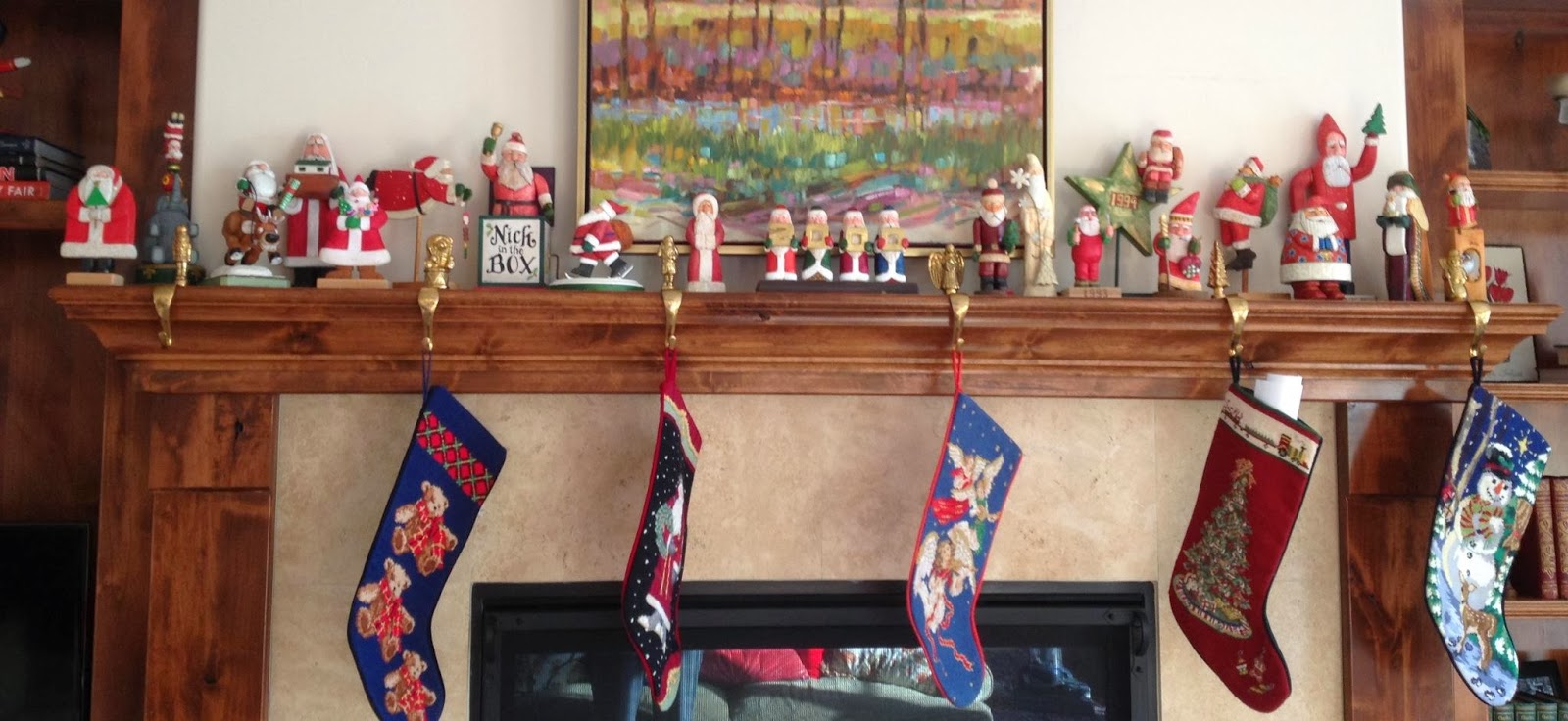
Original Santa by my father-in-law.
Brach's candies in honor of Bondy.
Bondy had benign essential tremors, and her voice sounded like Katharine Hepburn's.  She knew one piano piece and played it every day to keep the shaking and the arthritis at bay.  She did the crossword puzzle in ink, as do I, and instructed me to marry a man who could cook, which I did. She loved golf and duplicate bridge.  Chocolate was her favorite fruit.

When she was older and suffering from mild dementia, Bondy saw people in the trees.  They were always watching her but generally weren't threatening.  My mom, Peggy, took her out to lunch every day.  She preferred the $0.99-cent menu at Wendy's and would often eat half of her soggy junior cheeseburger and wrap the other half up for my mom to take home to my brother.  (My brother never ate after other people.)  She didn't understand answering machines.  One day my mom came home, pressed the play button, and after the beep heard a long pause, followed by quiet, shaky, drawn-out "Daaaaaaaammmmmmmiiiiitttt."

Bondy waited until we all came by to say goodbye before she passed away on November 11, 2000.  She had planned to reach 100 but came up eight years short.

I think about Bondy, and my mom, whenever I pick up my father-in-law from his retirement community and take him out to lunch (or to the pharmacy or one of the countless -ologists we visit on a monthly basis).  Peggy had an octogenarian mother and kids under ten long before anyone coined the term "Sandwich generation."  She also had the patience of a saint, especially since by then it took Bondy almost an hour to eat that half cheeseburger (or two out of four chicken nuggets).

Even though Bondy's final decade was dominated by nursing homes, hospitals, and fast food, my strongest memories are those like the stories above.  It gives me hope that one day my children won't think of their grandfather, my father-in-law, as someone afflicted with chronic depression and Parkinsonism, but instead remember him as a quiet, smiling grandpa who taught them to draw at his drafting board, carved a Santa each year for Christmas, and gave them a butterscotch candy at the end of every visit.  Werther's, not Brach's, but the memories can be just as sweet.

Tuesday, December 10, 2013

Let's start at the very beginning...

Here is a partial list of things I cannot do:
  1. Host the office Christmas party AND keep up with the laundry
  2. Work from home when behind on said laundry
  3. Resist eating leftovers from said office Christmas party while pretending to work from home
  4. Train a dog
  5. Pack lunch boxes the night before in the hopes of getting kids to school on time
  6. Love my husband enough to feign interest in Alaska-based shows on Discovery and History channels
  7. Convince my father-in-law that he needs to add vegetables into his diet and go to a senior exercise class
  8. Drink caffeine (migraine trigger)
  9. Resist drinking just a little caffeine (1/3-caff Americano)
  10. Waterski
If we're going to be spending time together here, I just thought you should know this about me.  Especially when most blogs are based on things that people CAN do -- like prepare perfect paleo meals with backyard-grown, organic, Omega-3/6/9-packed foods that all kids everywhere will love; write with poignant humor about dysfunctional family moments that make the rest of us feel better and inferior at the same time; create creative creations for festive friend and family fellowship; or opine intelligently and persuasively on the most critical political issues of our day.  I read these blogs.  I love these blogs.  This is not one of those blogs.

The fact of the matter is that I don't consider myself to be particularly funny or insightful or inspirational.  And it's been about twenty-two years since I was the smartest person in the room.  (I peaked early.)  

But I am a writer, and writers write.  And we research, and we notice things, and we remember the things we notice and want to share them with others.  Or, as my husband says, we eavesdrop on the world and then share information that wasn't ours the first place.  Well, actually he just says that about me.

So when my nine-year-old lowers one brow and chastises me, "Mom! Mrs. O manages to review math facts with us WITHOUT bursting into song!," or when my father-in-law tries to sneak the expired food out of the trash bag after I clean out his fridge, or when I reach so great a state of frustration that I think occupational therapy might be in order for my 10-month-old yellow lab, I'll do my best to wrap it up in an appetizing way in this virtual lunchbox.  My hope is that you'll find something familiar and comforting in each bite of the baloney sandwich.